Hun Manet: Cambodia's Fight Against Online Scams Is No Publicity Stunt
Prime Minister Hun Manet says Cambodia's crackdown on online scams is sincere, while cautioning that fighting cross-border crime must not be used as a pretext to occupy another nation's territory.
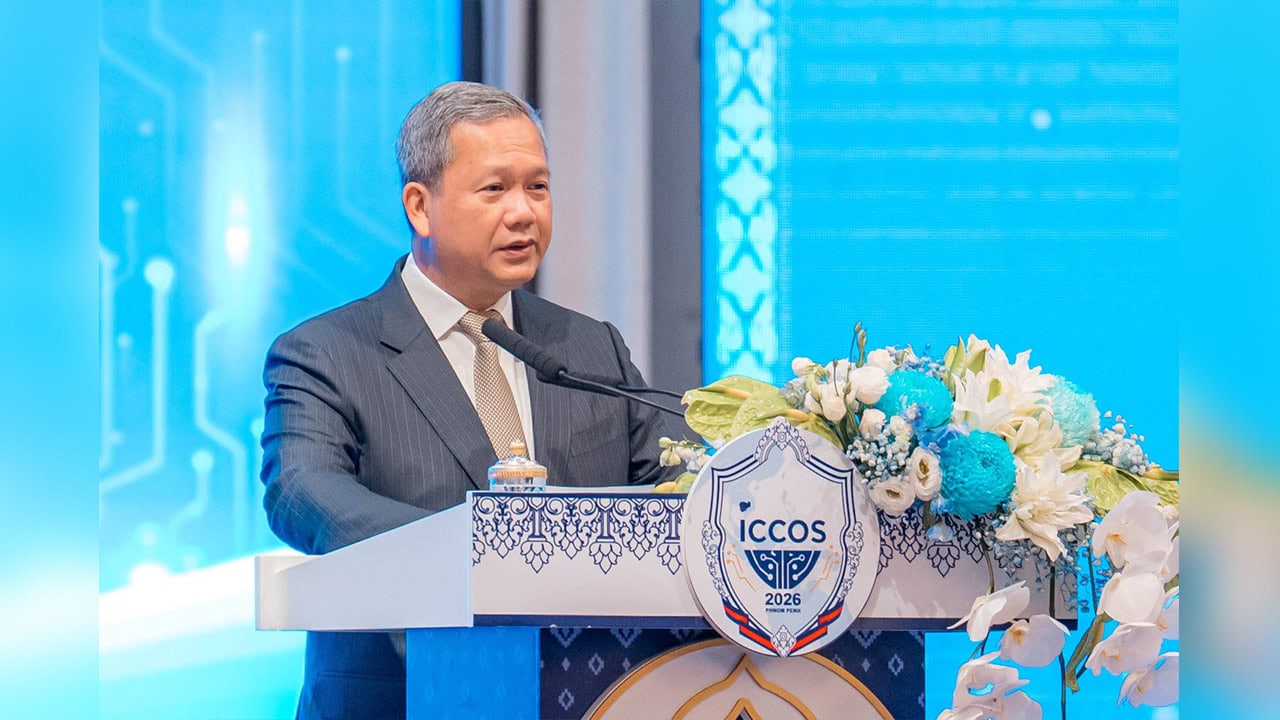
Prime Minister Hun Manet has insisted that Cambodia's crackdown on online scams is genuine and not merely for appearances, while warning that transnational crime must never serve as an excuse for violating another country's territory.
Speaking on September 23, Manet opened the International Conference on Combating Online Scams (ICCOS) in Phnom Penh. The gathering drew roughly 500 delegates representing 27 nations, alongside seven UN agencies and non-governmental organisations.
"Cambodia will never be a safe haven for online scams. This transnational crime is a recent post-Covid-19 phenomenon, one that is entirely foreign to our national cultural values and identity. Cambodia will not allow criminal syndicates to undermine our country's progress and the livelihood of over 17 million Cambodian people," he said.
He pointed out that the online scam trade neither originated in Cambodia nor is limited to the country. The Kingdom's initial encounter with the problem grew out of its online gambling and casino sectors, as criminal groups moved swiftly across national boundaries.
"Cambodia takes full ownership for securing our borders, enforcing our laws and restoring the integrity of our national jurisdictions. Accountability must be proven through uncompromising internal actions," he said.
"We treat law enforcement as a standing national security obligation and not a public relations campaign. We are focusing our efforts on permanently eradicating criminal networks and preventing their re-emergence," he added.
Manet said Cambodia had enacted anti-scam laws and cooperated with police agencies from China, the United States, Japan, South Korea and Australia, as well as fellow ASEAN members, other allied nations and international bodies such as the UNODC, Interpol and the IOM.
A warning against weaponising the issue
In an apparent nod to Thailand, which cited the fight against online scams as justification for occupying Cambodian territory last year, Manet argued that efforts to combat cross-border crime should never be turned into a weapon.
"Online scam issues should never be weaponised by any nation against another, nor should anti-scam objectives be used as a pretext by any nation to use force to attack or occupy another nation's sovereign territory, which is a clear violation of the principles of international law. This phenomenon, unfortunately, has happened to Cambodia in certain areas along the border with Thailand," he said.
"On the contrary, anti-online scam efforts should be a reason for nations to work together with sincerity and mutual respect in order to tackle the issue for common benefit. No single country can effectively tackle cross-border challenges alone," he added.
Five points for cooperation
To strengthen the international response, Manet put forward five priorities: sharing intelligence in real time, conducting sophisticated financial investigations, aligning legal and operational systems more closely, forging partnerships between the public and private sectors, and protecting victims.
"Our shared determination to confront this complex challenge must be matched with concrete and collective actions. In this spirit of mutual trust and shared responsibility, Cambodia looks forward to its international partners adopting the Phnom Penh Declaration on September 24 — a testament to our collective resolve to break the chain and eradicate online scams once and for all," he said.